
Radon Testing in Ohio
Ohio sits in one of the highest radon regions in the country. We run licensed, 48-hour continuous monitor tests that hold up in a real estate transaction. We don't sell mitigation systems, so the number we give you is just the number.
$175 flat, whether you bundle it with your home inspection or book it on its own.
Why radon matters more in Ohio than almost anywhere else
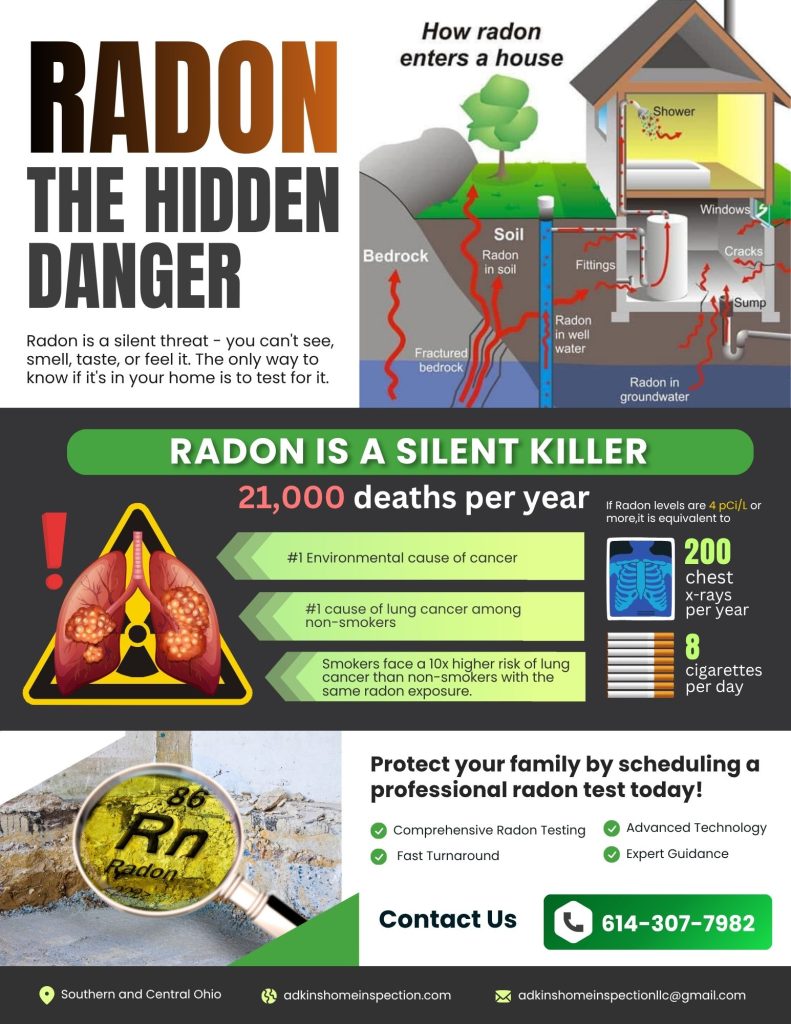
Radon is a naturally occurring radioactive gas produced as uranium in soil and bedrock breaks down. You can't see it, smell it, or taste it. It seeps up through foundation cracks, sump pits, floor drains, crawl space floors, and utility penetrations, then builds up inside the house, usually worst in the basement and lowest living levels.
Glacial deposits and uranium-bearing shale across the middle of the state produce unusually high soil gas concentrations. That makes this a local problem, not an abstract one.
County averages don't tell you anything about your house. Two homes on the same street, built by the same builder in the same year, can test 1.8 and 9.4. The only way to know your number is to measure your house.
Average indoor radon in the counties we work in
| County | Reported average |
|---|---|
| Licking | Above 8.0 pCi/L |
| Franklin | 6–8 pCi/L |
| Fairfield | 6–8 pCi/L |
| Pickaway | 6–8 pCi/L |
County averages cited from a study referenced by the Ohio Department of Natural Resources, Division of Geological Survey. The EPA action level is 4.0 pCi/L.


Professional continuous monitors, not mail-away charcoal kits
A charcoal kit gives you one averaged number from a lab days later, with no way to see what happened hour by hour. A continuous monitor logs a reading every hour and records tamper indicators: motion, temperature, humidity, and barometric pressure. If a window was opened at hour 19, the data shows it. That's what makes a result defensible when there's money on the table.
Placement
The monitor goes in the lowest livable area, following ANSI/AARST protocol. It sits away from exterior walls, windows, drafts, heat sources, and standing water, and is raised off the floor.
48-hour minimum run
The device stays undisturbed for at least 48 continuous hours under closed-building conditions.
Retrieval and analysis
We collect the device, review the hourly data for anomalies, and confirm the test is valid. We place and retrieve the monitor ourselves, so no one is left to self-report conditions.
Report delivery
You get a written report with the average concentration, the full hourly graph, test conditions, device serial and calibration information, and a plain-English interpretation, typically within 24 hours of retrieval.
Closed-building conditions
Closed-building conditions must be kept for 12 hours before the test begins and for the entire test period. Please pass this to whoever is living in or showing the home.
Required
- All exterior windows closed on every level, including the basement
- Exterior doors closed except for brief, normal entry and exit
- Normal use of the heating or air conditioning
- No whole-house, window, or attic fans that pull in outside air
- Fireplace and wood stove use kept to a minimum
- Nothing placed on, near, or against the monitor
- Don't move, unplug, cover, or "check" the device
Also avoid
- Airing out the house before a showing
- A dehumidifier running directly next to the monitor
- Contractor work that props doors open
- Extended propping of crawl space or basement doors
If the house was open before the test started, we can still run a valid test by extending the duration. Tell us up front and we'll plan around it.
For sellers and listing agents: showings can continue during a test. Buyers and agents just close the door behind them and leave the device alone. We provide a printed placard for the monitor and can text the listing agent when the test goes live.
Understanding your number
| Result | What it means | Typical next step |
|---|---|---|
| Below 2.0 pCi/L | At or near the national indoor average | No action indicated |
| 2.0 – 3.9 pCi/L | Below the action level, but not zero risk. EPA suggests considering mitigation in this range | Optional. Many buyers retest after a year of occupancy |
| 4.0 pCi/L or higher | At or above the EPA action level | Mitigation recommended |
| 8.0+ pCi/L | Substantially elevated | Mitigation strongly recommended. Not unusual in this region |
There is no known safe level
The 4.0 pCi/L action level is a policy threshold, not a biological cliff. Risk is continuous. A 3.8 is not meaningfully safer than a 4.1.
Radon fluctuates
Levels are usually highest in winter, when houses are sealed up. A 48-hour snapshot in April may read lower than the same house in January. If a short-term result lands between 2 and 4 and you plan to live there, a 90-day test after move-in gives a truer annual average.
Buyers, sellers, and agents
For homebuyers
Test during your inspection period, not after closing. Once you own the home, radon is your problem and your expense. During the contingency window, it's a negotiating item.
- Order the test on day one of your inspection, so it fits the standard Ohio contingency without extending it
- New construction often tests higher, not lower
- Slab and crawl space homes test high routinely
- If a mitigation system exists, test it. A fan doesn't prove the number is low
A typical sub-slab system in Central Ohio runs about $1,000–$2,000 installed. It's a known cost, which makes it a reasonable thing to negotiate.
For home sellers
A pre-listing test is one of the few inspection items you can fully control before it becomes a negotiation.
- You set the timeline for mitigation bids and choose your contractor
- "System installed 2026, tested at 1.9 post-mitigation, documentation available" is a listing feature
- A documented, mitigated, retested home takes radon off the table
- Ohio's disclosure form asks about known radon results, so test early enough to fix and disclose the fix
We test. We don't mitigate.
Adkins Home Inspection does not sell, install, or profit from radon mitigation systems. In Ohio, a company that both tests and mitigates must disclose that conflict in writing. We have no stake in your result.
If your home tests at 1.6, we say so and you're done. If it tests at 9.1, we hand you the data and you get bids from licensed mitigation contractors. We'll explain what the quotes mean, but we won't be one of them.
Central & Southern Ohio
Testing is available across Columbus, Gahanna, Westerville, Dublin, Hilliard, Grove City, Pickerington, Reynoldsburg, Lancaster, Circleville, Chillicothe, Newark, and Delaware, plus surrounding communities.
Frequently asked
How long does a radon test take?
A minimum of 48 continuous hours under closed-building conditions. We place the monitor at your inspection and return two days later. Your report usually follows within 24 hours.
Can I stay in the house during the test?
Yes. Cooking, showering, laundry, and running the HVAC are all fine. Keep exterior windows and doors closed, skip whole-house and window fans, and leave the monitor alone.
Can we still show the house during a test?
Yes, as long as doors are closed behind each visit and no one touches the device. A placard on the monitor explains this.
My house is brand new. Do I still need to test?
Yes. New homes often test higher. Tight, well-sealed construction traps soil gas that would have leaked out of an older, draftier house.
My house is on a slab or crawl space with no basement. Does that help?
No. Radon enters through the floor system regardless of foundation type.
My neighbor tested low. Doesn't that cover me?
No. Nearby homes often test very differently because soil, foundation, and tightness vary house by house. Your number is your own.
The home already has a mitigation system. Should I test it?
Yes. A system proves someone once had a problem, not that it's solved. Fans fail, systems get undersized, and the gauge on the pipe only shows suction, not indoor concentration. We do find failures in mitigated homes.
Do you do the mitigation too?
No, by choice. Without a financial interest in your result, we can give you an honest read. We'll help you understand contractor bids.
Is radon testing regulated in Ohio?
Yes. The Ohio Department of Health licenses radon testers, mitigation specialists, and laboratories. Anyone testing for radon in a real estate transaction in Ohio must hold an ODH license. Ask any provider for their license number.
Know your number before it costs you
In a region where county averages run well above the EPA action level, "probably fine" isn't a plan. A radon test is 48 hours and a known cost: $175 flat, whether bundled with an inspection or booked on its own.