
Mold Inspection & Testing in Ohio
Independent testing from an inspector who doesn't sell remediation.
If you’re smelling something musty in the basement, staring at dark staining on your attic sheathing, or you just got a home inspection report that says “suspect microbial growth” – you need an answer, not a sales pitch.
Adkins Home Inspection provides mold inspection, moisture diagnosis, and laboratory air quality testing for homeowners and home buyers across Columbus, Lancaster, Chillicothe, Gahanna, and the surrounding Central and Southern Ohio communities.
Here’s the part that matters most: we do not perform mold remediation. We have no financial interest in whether your test comes back clean or dirty. That independence is the entire product.
Schedule Your Mold Inspection | Call or text 614.307.7982
Why Central and Southern Ohio Homes Grow Mold
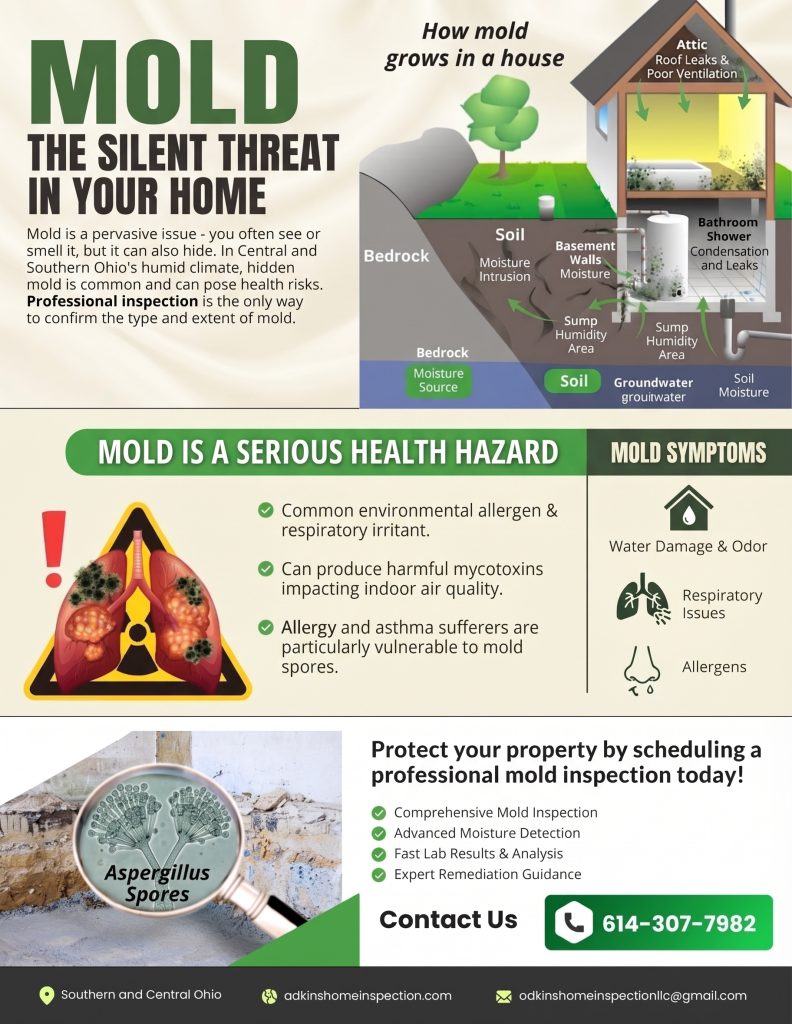
Mold needs three things: a food source, a spore (already everywhere), and moisture. In our part of Ohio, only one of those is ever really in question – moisture. And our region hands it out generously.
Our summers are genuinely humid. From June through early September, Central Ohio regularly runs dew points in the upper 60s and low 70s. When that outdoor air finds a 58-degree basement wall or a cool crawlspace floor joist, it condenses. This is why so many Ohio crawlspace mold problems have nothing to do with a leak – the vents themselves are the delivery system.
Our soil holds water. Much of Central Ohio sits on dense glacial till and clay that drains slowly. Water that lands next to your foundation doesn’t disappear downward – it sits, and it looks for a way in through block joints, cove joints, and tie rod holes.
Our river valleys stay wet. Homes along the Scioto, Hocking, Olentangy, and Paint Creek corridors – much of Ross, Hocking, Pickaway, and southern Fairfield County – deal with higher water tables and periodic saturation that older foundations were never sealed against.
Our housing stock is old. Chillicothe, downtown Lancaster, German Village, Clintonville, and Circleville are full of beautiful pre-1940 homes with stone or unparged block foundations, dirt-floor crawlspaces, and zero vapor barrier. These homes have been damp for a century. They just weren’t finished and carpeted until 1998.
Our winters make attics sweat. Ohio’s freeze-thaw cycling plus a bath fan venting into the attic instead of through the roof equals condensation on the north-facing roof sheathing every January. This is the single most common attic mold pattern we find in Central Ohio, and homeowners almost never know it’s happening.
The 5 Places We Find Mold Most Often in Ohio Homes
1. North-facing attic roof sheathing. Dark gray or black staining, often in a stripe pattern following the rafter bays. Cause is almost always warm moist air from the house entering the attic — bath fans terminating in the attic, unsealed attic hatches, recessed can lights, or blocked soffit vents smothered by insulation.
2. Crawlspace floor joists and subfloor. White or gray fuzzy growth on the underside of the subfloor, usually worst in mid-summer. Cause is typically missing or torn vapor barrier over exposed soil, plus open foundation vents pulling humid summer air across cold surfaces.
3. The basement cove joint and lower wall. Efflorescence, staining, and growth in the bottom 12–18 inches of a block wall. Cause is usually exterior — downspouts discharging within three feet of the foundation, negative grade, or a failed footer drain.
4. Behind finished basement walls. The most expensive one to find late. Drywall or paneling installed directly against block, with fiberglass batt insulation and carpet over concrete, creates a sealed pocket that stays damp. You often smell it long before you see it.
5. Bathrooms, window frames, and around AC supply registers. Poor exhaust ventilation, single-pane or failed thermal windows, and over-cooled rooms with humid air all create surface condensation.
What Our Mold Inspection Actually Includes
A mold inspection is a moisture investigation first and a lab test second. Anyone can put a pump on the floor and mail you a bill. Finding why the moisture is there is what actually saves you money.
Visual assessment of accessible areas — basement, crawlspace, attic, bathrooms, laundry, mechanical room, and any client-identified problem area.
Moisture meter readings — pin and pinless meters to identify elevated moisture content in framing, drywall, subfloor, and finishes.
Thermal imaging — infrared scanning to reveal temperature anomalies consistent with moisture behind finishes, in ceilings, and at exterior walls, without cutting anything open.
Humidity and dew point measurement — because in an Ohio crawlspace, relative humidity is often the whole story.
Laboratory air sampling — calibrated spore trap cassettes drawn at a controlled flow rate, with a mandatory outdoor control sample taken the same day at the same property.
Surface sampling where warranted — tape lift or swab samples from visible suspect growth.
Accredited laboratory analysis — samples are analyzed by an independent third-party lab, with results typically returned in 2–3 business days.
A written report you can hand to a contractor, a seller, or an attorney — findings, photos, lab data, plain-English interpretation, and specific moisture-source corrections.
How We Test
Sampling is the easy part. Sampling in the right place, under the right conditions, with something to compare it against is what separates a defensible result from a piece of paper. Here's exactly how a mold inspection runs at your home.
Before we arrive: closed-house conditions
We'll ask you to do four simple things starting about 12 hours before the appointment. They matter more than most people expect — get them wrong and the results are unusable.
- Keep windows and exterior doors closed (normal entry and exit is fine). Open windows flood the house with outdoor air and mask the indoor picture entirely.
- Don't vacuum, dust, or deep clean the day of the inspection. Cleaning aerosolizes settled spores and can spike a reading that has nothing to do with active growth.
- Turn off air purifiers, HEPA units, and any air scrubbers left behind by a contractor. Those are designed to remove exactly what we're trying to measure.
- Leave the HVAC in its normal operating mode. We want the house as it actually lives, not as it looks for company.
If a remediation contractor has already been running equipment, tell us. We'll schedule around it.
Step 1 — We talk before we test
The first ten minutes are questions, not equipment. When did you first notice it? Is the smell seasonal, or year-round? Has the basement ever taken water, and how much? Any plumbing failures, roof leaks, or ice damming? Anyone in the house reacting?
For buyers, we read the Residential Property Disclosure Form first. Section D tells us where to look before we've taken a single step into the basement.
Step 2 — We find the water first
Mold is a symptom. Water is the disease. Before any sample gets collected, we work the building:
- Exterior first — grading, downspout discharge distance, gutter condition, window wells, driveway and patio slope back toward the foundation. A surprising number of Ohio basement mold problems are solved 15 feet from the house.
- Moisture meters — pinless scanning across drywall, subfloor, and framing to map elevated readings, then pin readings to confirm actual moisture content in wood.
- Thermal imaging — infrared scanning of ceilings, exterior walls, and below-grade walls to reveal the temperature anomalies that indicate moisture behind finishes, without cutting anything open. Thermal shows us where to point the meter; the meter confirms it. Neither one alone is proof.
- Hygrometer readings — temperature, relative humidity, and dew point logged in the basement, crawlspace, attic, and living space. In an Ohio crawlspace in August, this is frequently the entire diagnosis.
Step 3 — We decide where the samples go
Sample placement is a judgment call, and it's the part that gets outsourced to a checklist by companies running volume. We place samples based on what Step 2 found — the room with the complaint, the room with the elevated moisture, and a comparison room in the house that appears unaffected.
We do not scatter a dozen cassettes around the house to inflate an invoice. If two samples answer the question, we take two.
Step 4 — The outdoor control sample (non-negotiable)
Every job includes an outdoor control sample, collected the same day, at the same property, in the same weather. Outdoor air always contains mold spores — that's normal and expected. Without that control, indoor numbers are just numbers with nothing to measure them against.
If a company quotes you a mold test with no outdoor control, they are selling you a result that cannot be interpreted. That's the single fastest way to spot a bad operator in this trade.
Step 5 — Air sampling
We use spore trap cassettes on a calibrated air pump. A measured volume of air is drawn across an adhesive-coated slide inside the cassette; airborne particles impact and stick to it, and the laboratory reads the slide under a microscope.
- The pump is calibrated to a known flow rate, and run time is recorded so the lab can convert the catch into spores per cubic meter of air.
- Samples are collected at breathing height, away from supply registers, doorways, and anything that would create artificial air movement across the cassette.
- Time, location, flow rate, temperature, and humidity are logged for every single sample, indoor and outdoor.
Air sampling is what catches the problem you can't see — behind a finished basement wall, inside a chase, under a subfloor.
Step 6 — Surface sampling, when there's something to sample
If there's visible suspect growth, we sample it directly:
- Tape lift — a clear adhesive slide pressed to the surface, capturing the growth structure intact. This is what lets the lab tell the difference between actual growth on the material and spores that merely settled there — a distinction that matters a great deal when you're negotiating a repair credit.
- Swab — used for textured, rough, or irregular surfaces where tape won't make clean contact.
Surface sampling tells you what is growing there. Air sampling tells you what you're breathing. They answer different questions, and the right job often uses both.
Step 7 — Chain of custody
Every sample is labeled at the point of collection, logged on a written chain-of-custody form, and shipped to an independent third-party laboratory — a lab we don't own, aren't paid by, and have no financial relationship with.
That paper trail exists so the result holds up if this ends up in a negotiation, an insurance claim, or a courtroom. Photographs of every sample location go into the report alongside the data.
Step 8 — Results, then a phone call
Lab analysis typically returns in 2–3 business days. You receive a written report containing the raw lab data, our findings, photographs, the moisture sources we identified, and specific corrective recommendations in order of priority.
Then we call you and walk through it. Not a link to a PDF and good luck — an actual conversation, at no extra charge, until you understand what you're holding. If you want us on the phone with your contractor or your agent, we'll do that too.
Understanding Your Lab Report (What Nobody Tells You)
This is where most mold companies lose people, and where a few of them take advantage.
There is no federal or Ohio state standard for acceptable airborne mold. No legal limit exists. No number on your report means “pass” or “fail.” Any company that hands you a number and calls it a legal threshold is making it up.
Your results are read as a comparison, not a score. The indoor sample is compared against the outdoor control taken the same day. Outdoor air always contains mold spores — that’s normal. What matters is whether the indoor air shows spore types or concentrations meaningfully elevated above what’s naturally outside, and whether the species present are the kind associated with chronically wet building materials rather than with leaves and mulch.
“Every home contains mold.” That isn’t our disclaimer — it’s the language printed on the State of Ohio’s own Residential Property Disclosure Form. The goal is never zero. The goal is normal, and dry.
Visual identification of species is not possible. Nobody can look at a wall and tell you it’s Stachybotrys. If a contractor says “that’s black mold” without a lab result, that’s a sales tactic, not a finding.
We walk you through your report line by line, on the phone, at no additional charge.
Ohio Has No Mold License. Here's How to Vet Anyone You Hire.
This surprises most homeowners: Ohio does not license or certify mold inspectors or mold remediators. There is no state exam, no state registry, and no state database to check. Any Ohio company advertising itself as “state licensed for mold” is either confused or being deliberately misleading.
So the screening is on you. Four questions worth asking any mold company in Ohio:
- Do you also sell remediation? If yes, the person telling you that you have a problem is the same person who profits from the cure. Ask them how they manage that conflict.
- What third-party certification do you hold, and can I verify it? Certifications through organizations like MICRO or IAC2 are voluntary — but they’re something, and they’re verifiable.
- Which laboratory analyzes your samples, and are they independent of your company?
- Do you take an outdoor control sample? If not, the indoor results cannot be interpreted. Walk away.
For Home Buyers: When to Add Mold Testing
You are usually working inside a short inspection contingency window, so the decision needs to be quick and informed. Add mold testing to your home inspection if any of these are true:
- The home has been vacant, bank-owned, or utilities-off, especially through an Ohio summer with no air conditioning running.
- You can smell it — that damp, earthy basement odor is real information.
- The Residential Property Disclosure Form shows a “yes” under Section D, Water Intrusion, or the seller disclosed prior remediation.
- The home has a dirt-floor or vented crawlspace, common throughout Fairfield, Hocking, Ross, and Pickaway counties.
- The basement is finished and you can’t see the foundation walls behind the drywall.
- The attic shows staining, or bath fans don’t vent through the roof.
- The home is a flip with fresh paint on the basement walls – new paint over old staining is a pattern we see constantly.
- Someone in your household has asthma, allergies, or a compromised immune system. Some people are considerably more sensitive to mold exposure than others.
Scheduling mold testing at the same time as your home inspection is the cheapest and fastest path — one trip, one appointment, and lab results back well inside a typical contingency period.
Ohio-specific note for buyers: Section D of the state disclosure form asks the seller directly whether the property has ever been inspected for mold by a qualified inspector, and it explicitly encourages purchasers concerned about the issue to have one done. You are not being difficult by asking. The state form suggests it.
For Homeowners and Sellers
Before you list. A pre-listing mold and moisture inspection lets you find and correct problems on your schedule and at your price — not during a buyer’s inspection contingency, when a $400 downspout fix turns into a $6,000 credit demand and a shaky closing.
After a water event. Burst supply line, ice-dammed gutter, sump pump failure, washing machine hose, sewer backup. Mold can begin colonizing wet organic material within roughly 24 to 48 hours. If materials stayed wet longer than that, testing tells you whether the drying was actually successful.
Before you pay for remediation. Get an independent baseline. Without one, you have no way to prove the work you paid for accomplished anything.
After remediation — post-remediation verification. This is the one homeowners skip most often and regret most. Independent clearance testing after the remediator packs up is your only objective proof the job was done. Ask us about scheduling verification testing before you release final payment.
When you’re just tired of the smell. Chronic musty basement odor in an Ohio home is almost always solvable, and it’s usually solved outside the house with grading and downspouts rather than inside with a fogger.
Ohio Moisture Control: A Seasonal Checklist
| Season | What to do |
|---|---|
| Spring | (March–May): Walk your downspouts during an actual rainstorm. Extensions should discharge a minimum of 4–6 feet from the foundation. Confirm grade slopes away roughly 6 inches over the first 10 feet. Test your sump pump by filling the pit. Clear gutters of last fall's silver maple debris. |
| Summer | (June–September): Close your crawlspace vents, don't open them. Venting a crawlspace in July pumps 72-degree dew point air onto 62-degree surfaces. Run a basement dehumidifier targeting 45–50% relative humidity and confirm the drain line isn't clogged. Make sure the AC condensate line is actually draining. |
| Fall | (October–November): Clean gutters after leaf drop. Verify bath and kitchen exhaust fans terminate outside the building — through the roof or a wall cap, never into the attic or soffit. Check the crawlspace vapor barrier for tears from summer service work. |
| Winter | (December–February): Watch north-facing attic sheathing for frost. Run bath fans for 20 minutes after showering. Keep indoor humidity in the 30–40% range in cold weather. Address ice damming — that meltwater goes into wall cavities and doesn't come out. |


Frequently Asked Questions
How much does a mold inspection cost in Columbus or Lancaster, Ohio? Pricing depends on square footage, the number of laboratory samples needed, and whether it’s bundled with a full home inspection. Bundling with a home inspection is always the lower-cost path. Call or text 614.307.7982 for a firm quote — we’ll give you a number over the phone, not a “schedule a consultation” runaround.
How long do lab results take? Typically 2–3 business days from the accredited laboratory. We know buyers are working against contingency deadlines and we schedule accordingly.
Is a mold inspection included in a standard home inspection? No. A standard Ohio home inspection is a visual, non-invasive evaluation. If we observe suspect microbial growth we will absolutely note it in the report and photograph it — but identifying what it is requires laboratory analysis, which is a separate service.
Do you do the mold removal too? No, and that’s deliberate. We test, diagnose the moisture source, and document. We will not quote you a remediation job, which means our findings aren’t shaped by what we’d like to sell you afterward.
Is black mold dangerous? “Black mold” isn’t a scientific category — many common molds are dark. The species most people mean, Stachybotrys chartarum, is associated with chronically saturated cellulose materials like wet drywall. Individual sensitivity to mold exposure varies considerably, which is why the Ohio disclosure form notes that some people are more sensitive than others. Health questions belong with your physician; we handle the building.
Can you tell if it’s mold just by looking? We can tell you it’s suspect and worth testing. No one can identify a species visually, and any contractor who claims to is selling something.
My home inspector wrote “suspect microbial growth.” What now? That’s standard, appropriate language — it means visible growth was observed but not identified. Testing determines what it is and, more importantly, why it’s there.
Does homeowners insurance cover mold in Ohio? It depends entirely on the cause and your specific policy. Damage from a sudden, accidental event (a burst pipe) is treated very differently than damage from long-term seepage or deferred maintenance, which is typically excluded. Most Ohio policies also cap mold-related coverage. Read your policy and call your agent.
Do I have to disclose mold when I sell my Ohio home? Ohio Revised Code 5302.30 requires sellers to complete the Residential Property Disclosure Form and answer based on actual knowledge. Section D covers water intrusion, moisture damage, and whether the property has been inspected for mold. Disclosure questions are legal questions — talk to your real estate attorney, not your inspector.
Do you serve rural properties outside Columbus? Yes. We cover Fairfield, Ross, Hocking, Pickaway, Franklin, Perry, Licking, and surrounding counties, including rural properties on private drives.
Can you test just one room? Yes. Targeted testing for a single suspect area is available and is a common request for basements and nurseries.
Can you do testing after my remediation contractor finishes? Yes — post-remediation verification testing. Schedule it before releasing final payment.