
Radon Testing in Ohio
Ohio sits in one of the highest radon regions in the country. We run licensed, 48-hour continuous monitor tests that hold up in a real estate transaction - and we don't sell mitigation systems, so the number we give you is just the number.
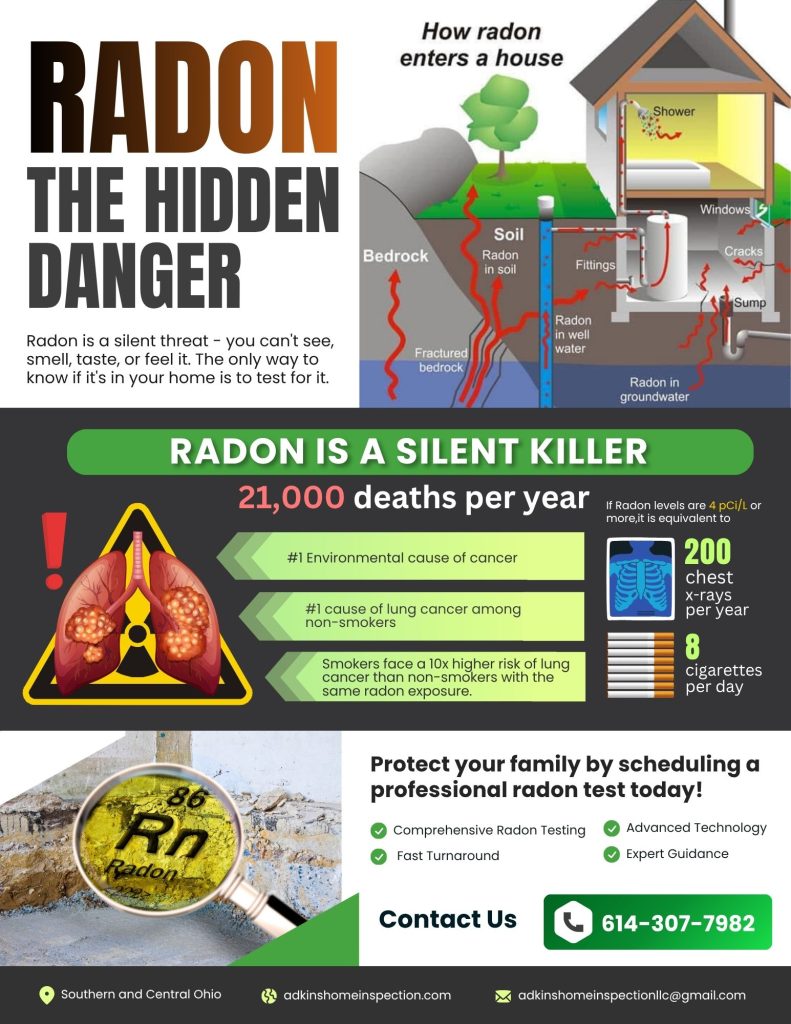
Why Radon Matters More in Ohio Than Almost Anywhere Else
Radon is a naturally occurring radioactive gas produced as uranium in soil and bedrock breaks down. You can’t see it, smell it, or taste it. It seeps up through foundation cracks, sump pits, floor drains, crawl space floors, and utility penetrations, and then it accumulates inside the house — usually worst in the basement and lowest living levels.
The EPA identifies radon as the second leading cause of lung cancer in the United States, behind smoking, and the leading cause among people who have never smoked.
Ohio’s geology makes this a local problem, not an abstract one. Glacial deposits and uranium-bearing shale across the middle of the state produce unusually high soil gas concentrations. Roughly 60% of Ohio’s 88 counties carry the EPA’s Zone 1 designation — the highest-risk category, meaning the predicted average indoor screening level exceeds the 4.0 pCi/L action threshold.
The counties we work in every day are among the worst:
| County | Reported average indoor radon |
|---|---|
| Licking | Above 8.0 pCi/L |
| Franklin | 6–8 pCi/L |
| Fairfield | 6–8 pCi/L |
| Pickaway | 6–8 pCi/L |
County averages cited from a study referenced by the Ohio Department of Natural Resources, Division of Geological Survey. The EPA action level is 4.0 pCi/L.
Here’s the part people miss: county averages don’t tell you anything about your house. Two homes on the same street, built by the same builder in the same year, can test 1.8 and 9.4. Soil chemistry, foundation type, how tight the house is, drainage, and even how the HVAC system runs all change the result. A neighbor’s test is not your test. The only way to know your number is to measure your house.
How We Test
We use professional continuous radon monitors (CRMs), not mail-away charcoal canisters.
That distinction matters in a transaction. A charcoal kit gives you a single averaged number from a lab days later, with no way to see what happened hour by hour. A continuous monitor logs a reading every hour and records tamper indicators — motion, temperature, humidity, and barometric pressure. If a window got opened on hour 19, the data shows it. That’s what makes a result defensible when there’s money on the table.
Our process:
- Placement. The monitor goes in the lowest livable area of the home, following ANSI/AARST protocol — positioned away from exterior walls, windows, drafts, heat sources, and standing water, and elevated off the floor.
- 48-hour minimum run time. The device stays undisturbed for at least 48 continuous hours under closed-building conditions.
- Retrieval and analysis. We collect the device, review the hourly data for anomalies, and confirm test validity.
- Report delivery. You get a written report with the average concentration, the full hourly graph, test conditions, device serial and calibration information, and a plain-English interpretation — typically within 24 hours of retrieval.
We place and retrieve the monitor ourselves. No one is left to self-report conditions.
Closed-Building Conditions - The Thing That Voids Most Tests
This is the single most common reason a radon result gets challenged or thrown out. Please read it and pass it to whoever is occupying the home.
Closed-building conditions must be maintained for 12 hours before the test begins and for the entire test period.
Required:
- All exterior windows closed, on every level, including the basement
- All exterior doors closed except for brief, normal entry and exit
- Normal use of the heating or air conditioning system (run it as you usually would)
- No use of whole-house fans, window fans, or attic fans that draw in outside air
- Fireplace and wood stove use kept to a minimum
- Nothing placed on, near, or against the monitor
- Do not move, unplug, cover, or “check” the device
Also avoid:
- Airing out the house before a showing
- Running a dehumidifier directly next to the monitor
- Scheduling contractor work that props doors open
- Extended crawl space or basement door propping
If the house was open before the test started, we can still run a valid test — the protocol allows for extending the duration — but it costs time. Tell us up front and we’ll plan around it rather than discovering it in the data.
Note for sellers and listing agents: showings can continue during a radon test. Buyers and agents just need to close the door behind them and leave the device alone. We provide a printed placard for the monitor and can send a text reminder to the listing agent when the test goes live.
Understanding Your Result
| Result | What it means | Typical next step |
|---|---|---|
| Below 2.0 pCi/L | pCi/L At or near the national indoor average | No action indicated |
| 2.0 – 3.9 pCi/L | Below the action level, but not zero risk. EPA suggests considering mitigation in this range | Optional. Many buyers retest after a year of occupancy |
| 4.0 pCi/L or higher | At or above the EPA action level | Mitigation recommended |
| 8.0+ pCi/L | Substantially elevated | Mitigation strongly recommended; not unusual in this region |
Two things worth understanding about the number itself:
There is no known safe level. The 4.0 pCi/L action level is a policy threshold, not a biological cliff. Risk is continuous. A 3.8 result is not meaningfully safer than a 4.1 — it’s just on the other side of a line someone drew.
Radon fluctuates. Levels are typically highest in winter, when houses are sealed up and the stack effect pulls soil gas inward, and lowest in mild weather with natural ventilation. A 48-hour snapshot in April may read lower than the same house would in January. If your short-term result comes back in the 2–4 range and you plan to live there, a 90-day long-term test after move-in gives you a truer annual average.
For Homebuyers
Test during your inspection period, not after closing.
Once you own the home, radon is your problem and your expense. During the inspection contingency window, it’s a negotiable item. That timing difference is worth $1,000–$2,500 to you.
What to do:
- Schedule the radon test at the same time as your home inspection. We deploy the monitor at the inspection and return 48 hours later. It fits inside a standard Ohio inspection contingency period without extending it — but only if you start on day one, not day five.
- Don’t skip it because the house is new. New construction is frequently worse. Tight modern envelopes hold soil gas in, and new slabs and foundations settle and crack. Age of the house tells you nothing.
- Don’t skip it because the house has no basement. Slab-on-grade and crawl space homes test high routinely. The gas enters through the floor system regardless of what’s under it.
- Ask whether an existing mitigation system is actually working. A radon fan on the side of the house is not proof of a low number. Fans fail, systems get undersized, and the manometer gauge on the pipe only tells you the fan is pulling suction — not what the indoor concentration is. If the home has a system, test it. We test post-mitigation homes regularly and find failures.
- Get the paperwork if a system exists. Ask for the installation date, the installer’s Ohio license number, the post-mitigation test result, and any warranty.
If the result comes back high, you have options:
- Ask the seller to install a mitigation system before closing, with a post-mitigation test confirming the result is below 4.0
- Ask for a credit at closing and handle the installation yourself, on your own schedule and your own contractor
- Negotiate a price reduction
- Walk, if your contingency allows it
A typical sub-slab depressurization system in Central Ohio runs roughly $1,000–$2,000 installed depending on foundation type and complexity. It is a solved problem with a known cost — which is exactly why it’s a reasonable thing to negotiate rather than a deal-breaker. Elevated radon is not a reason to abandon a house you love. It’s a reason to fix it before you move in.
For Home Sellers
A pre-listing radon test is one of the few inspection items you can fully control before it becomes a negotiation.
Here’s the pattern we watch play out constantly: the seller doesn’t test, the buyer does, the result comes back at 7.2, and now the buyer is negotiating from a position of alarm — during the contingency window, on a deadline, with an emotional read on a number they’ve never seen before. What could have been a $1,400 line item becomes a $4,000 concession, a delayed closing, or a dead contract.
What testing first gets you:
- You control the timeline. If the result is elevated, you get mitigation bids on your schedule and pick your contractor, instead of accepting whatever the buyer’s timeline forces.
- You control the narrative. “Radon system installed 2026, tested at 1.9 post-mitigation, documentation available” is a feature in the listing. A surprise 7.2 discovered by the buyer is a problem.
- You remove a renegotiation lever. A documented, mitigated, retested home takes radon off the table entirely.
- A clean low result is a selling point. In a Zone 1 county, a documented 1.4 pCi/L is worth putting in the remarks.
Ohio disclosure: Ohio’s Residential Property Disclosure Form asks sellers about known hazardous materials and conditions, including radon. Once you know a result, you generally have to disclose it — you can’t test, dislike the number, and un-know it. That’s not a reason to avoid testing; it’s a reason to test early enough to fix the issue and disclose the fix instead of the problem. Talk to your agent or attorney about how your specific result should be represented on the form.
If you’re mitigating before listing: use an ODH-licensed mitigation contractor, keep the installation documentation, and have a post-mitigation test run to confirm the system works. Then hand the buyer a folder instead of an argument.


We Test. We Don't Mitigate.
Adkins Home Inspection does not sell, install, or profit from radon mitigation systems.
This is deliberate. In Ohio, a company that both tests and mitigates is required by administrative rule to disclose that conflict in writing — because the incentive problem is obvious. When the same business that reads the number also sells the fix, the number gets more interesting.
We have no financial stake in your result. If your home tests at 1.6, we say so and you’re done. If it tests at 9.1, we hand you the data and step out of the way while you get bids from licensed mitigation contractors. We’re happy to explain what the quotes mean and what to look for in a system design. We just don’t want to be the ones selling it to you.
Service Area
We provide radon testing throughout Central and Southern Ohio, including Columbus, Gahanna, Westerville, Dublin, Hilliard, Grove City, Pickerington, Reynoldsburg, Lancaster, Circleville, Chillicothe, Newark, Delaware, and the surrounding communities of Franklin, Fairfield, Licking, Pickaway, Ross, Delaware, and Union counties.
Frequently Asked Questions
How long does a radon test take? A minimum of 48 continuous hours under closed-building conditions. We deploy the monitor at your home inspection and return two days later to retrieve it and pull the data. Your report typically follows within 24 hours of retrieval.
Can I stay in the house during the test? Yes. Normal living is fine — cooking, showering, laundry, running the HVAC. You just need to keep exterior windows and doors closed, skip whole-house and window fans, and leave the monitor alone.
Can we still show the house during a radon test? Yes. Showings are fine as long as doors are closed behind each visit and no one touches or moves the device. We leave a placard on the monitor explaining this.
My house is brand new. Do I still need to test? Yes — and new homes often test higher, not lower. Tight, well-sealed modern construction traps soil gas that would have leaked out of a draftier older home. Age is not a predictor.
My house is on a slab / crawl space with no basement. Does that help? No. Radon enters through the floor system regardless of foundation type. Slab and crawl space homes routinely test above the action level in Ohio.
My neighbor tested low. Doesn’t that cover me? No. Adjacent homes commonly produce very different results because soil chemistry, foundation condition, and building tightness vary house by house. Your number is your own.
What if the home already has a radon mitigation system? Test it. A system’s presence proves someone once had a problem — it doesn’t prove the problem is currently solved. Fans fail, systems get undersized, and the gauge on the pipe only confirms suction, not indoor concentration. We test mitigated homes regularly and do find failures.
Do you do the mitigation too? No, by choice. We don’t sell mitigation, so we have no financial interest in your result. We’ll help you understand contractor bids, but we won’t be one of them.
What does mitigation cost in Central Ohio? Most residential sub-slab depressurization systems fall in the $1,000–$2,000 range, depending on foundation type, slab condition, and system complexity. Get more than one bid, and always confirm with a post-mitigation test.
Does a high radon result mean I should walk away from the house? Almost never. Radon is one of the few inspection findings with a reliable, permanent, moderately priced fix. It’s a negotiation item, not a structural condemnation.
Is radon testing regulated in Ohio? Yes. The Ohio Department of Health licenses radon testers, mitigation specialists, mitigation contractors, and radon laboratories. Anyone testing for radon in a real estate transaction in Ohio is required to hold an ODH license. Ask any provider for their license number.
Know Your Number Before It Costs You
In a region where county averages run double the EPA action level, “probably fine” isn’t a plan. Whether you’re two days into an inspection contingency or three months out from listing, a radon test is 48 hours and a known cost — and it’s a lot cheaper than finding out during someone else’s negotiation.
Schedule Your Radon Test Now! (Click the button below)